
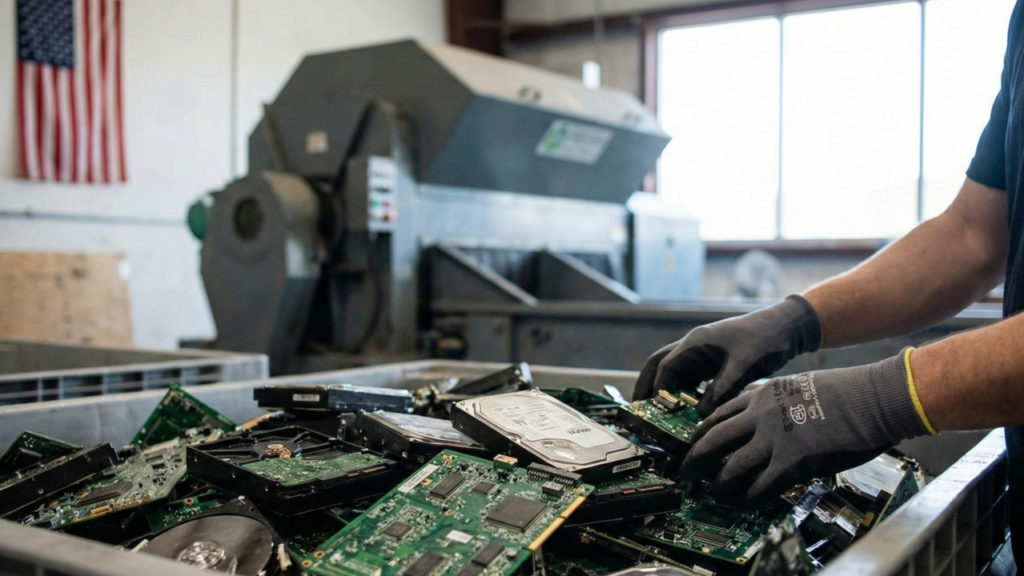
- One ton of recovered rare-earth oxide takes roughly 1.5 million enterprise hard drives.
- Only hyperscale and large enterprise volumes clear that threshold.
- Recovery depends on logistics and custody as much as on chemistry.
The math behind domestic magnet recovery is unforgiving, and it is why recycling has stayed a footnote in the critical-materials conversation.
A single enterprise hard drive contains a voice-coil magnet weighing a few grams. Neodymium, praseodymium and dysprosium make up a fraction of that. Run the arithmetic across a full ton of recovered rare-earth oxide and the number lands somewhere near 1.5 million drives, which is not a figure a regional processor can reach in a year.
Recovery only works where the volume already exists. Everyone else is operating below the threshold where the chemistry pays for itself.
That single constraint explains most of what looks strange about this market. Recovery only works where the volume already exists, which means hyperscale data centres, large enterprise refresh cycles and energy assets reaching end of life at the same moment. Everyone else is operating below the threshold where the chemistry pays for itself.
drives to recover one ton of rare earths
average to develop a new US mine
of global rare-earth refining sits in China
The timeline problem
Opening a new mine in the United States takes close to three decades once permitting is counted, and the country holds almost no heavy rare earths in the ground regardless. Recycling is the only lever that moves on the same timescale as demand from defence programmes, AI infrastructure and the energy transition.
The assets are already here. They are sitting in racks that will be decommissioned this quarter. Either the magnets inside them re-enter a domestic supply chain, or they leave the country as mixed scrap.
The assets are already here. They are sitting in racks that will be decommissioned this quarter.
What has to be true operationally
At this scale, recovery is mostly a logistics problem. Drives arrive as data-bearing assets, so destruction has to happen first, under NIST 800-88, documented per serial. Only then does the magnet become feedstock. A chain that hands off between four companies loses both the paperwork and the material.
Running destruction, recovery and refining inside one system makes that volume usable, and lets a customer see, per serial, where their material went.
See how the recovery pathway works, from certified destruction through high-purity oxide.
Critical materials