
Critical Materials & Defense
Rare Earth Magnet RecoveryCMR Joint VentureStrategic PartnersWind TurbinesCritical materials · August 2026
Why 1.5 million hard drives equal one ton of rare earths
The economics of domestic magnet recovery only work at a scale most of the industry has never had to reckon with.
China controls roughly 70% of global rare-earth mining and nearly 90% of refining, the step that turns ore into the oxides used in magnets. The United States has almost no heavy rare earths in its own mines, and developing a new one takes close to three decades on average, nearly a decade of that in permitting alone. None of that timeline matches the pace at which defense systems, AI infrastructure and the energy transition are consuming these materials.
Recycling is the one lever that moves fast enough to matter in the near term. Neodymium, dysprosium, praseodymium and terbium do not disappear when a hard drive or a wind turbine reaches end of life. They sit inside the magnet, recoverable at usable quality when the equipment is processed for recovery. Shredding, export and landfill lose them.
The volume problem
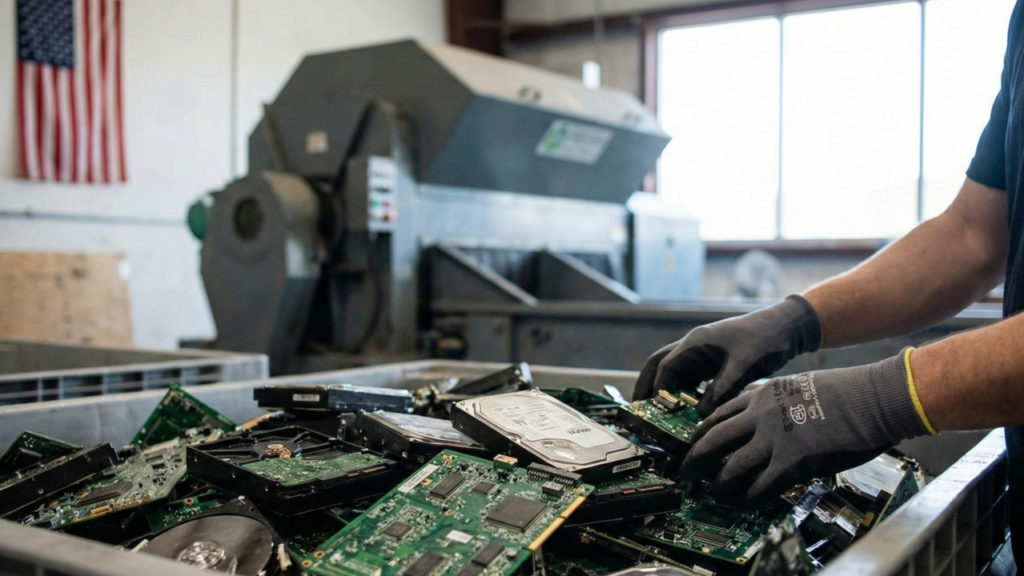
The catch is scale. A single hard drive carries only a few grams of magnet material. Recovering one ton of rare earths, enough for a meaningful batch of high-purity oxide, takes roughly 1.5 million drives. That volume does not exist in a small business's server closet or even a mid-sized company's data center refresh.
It exists in three places: hyperscale cloud providers refreshing entire data centers on a rolling cycle, large enterprises retiring thousands of drives at once during a technology refresh, and government fleets replacing equipment on a mandated schedule. These are also the organizations carrying the most sensitive data on that hardware.
Why this sits inside the system
Rare-earth recovery cannot be bolted onto a standard ITAD contract as an afterthought. It requires the same chain of custody as data destruction, tracked at serial level, because the drives carrying recoverable magnets are the same drives that need certified sanitization first. Separating the two into different vendors reintroduces the hand-offs the industry is trying to eliminate.
REcapture runs magnet recovery on the same system as destruction and disposition reporting. A customer generating drives at hyperscale volume gets one certificate of destruction, one recovery report, and one accounting of where the neodymium and dysprosium went, with no records to reconcile across vendors.
Beyond hard drives
The same math applies to wind turbines, which carry far more magnet mass per unit than a drive but generate that volume more slowly. Recovering rare earths from retired turbine generators is a smaller-count, larger-mass version of the same problem, and it runs through the same recovery pathway.
Recovery at usable quality is already proven. The constraint is volume, which is a scheduling and logistics problem. That is why the customers who generate feedstock at scale are also the ones who stand to gain the most from bringing it back into domestic supply.
Generating retired drives, motors or turbines at hyperscale volume? Let's model the recovery value.
Talk to an expert